

HARO, aka Help A Reporter Out, is an excellent platform to build brand awareness, get high-quality links, and improve EAT. However, the real question is how to use HARO for link building and PR. It's critical because typically 2 to 3 responses out of 10 are successful in HARO. Also, on average, a journalist gets 70 to 100 responses for each query, which makes the job harder.
So, here’s the secret recipe to use HARO for your link-building purpose:
"Use Professional emails with proper signatures, filter out the queries related to your niche and expertise, respond as fast as possible, and be concise. Also, you should be patient, track the responses for their outcomes, and use compelling responses. Lastly, you can even look for various alternatives to HARO."
Do all these seem rocket science to you? Well, make a few minutes out of your busy schedule and read out suggestions on HARO for link-building to boost your business and PR.
What Is HARO?
Since you came here, you already probably know about HARO. Still, it's always good to revitalize your memory with some insight into it before you know how to use it.
HARO is a platform that connects reporters, journalists, and researchers from famous websites, journals, and companies with bloggers, brands, and other websites. Journalists and reporters look for real stories, suggestions, and insights about their queries through HARO. The platform sends these queries to its subscribers through daily emails.
You can respond to these queries based on your expertise through proper and helpful suggestions. Once the reporter finds your responses useful for their reports, they will use them in their articles, and you will earn a backlink from the published content.
The process appears straightforward. However, it requires patience, fast response, practical answers, and a strategic approach. All these are worthwhile since you will get links from Mashable, Forbes, The Wall Street Journal, or similar websites.
How To Use HARO For Link Building And PR
Did you try and fail to get links through HARO? Make your failure your inspiration, and read through our guidelines to use HARO more effectively than you ever thought.
Sign Up and Set Preferences
HARO offers different subscription options for users. You can subscribe to their free basic plan or the paid version, “HARO Master.” Thankfully, the free plan is enough for most beginners. It lets you receive daily emails containing relevant queries.
Once you sign up, you will create a profile specifying your name, expertise, and industry. Here's where you set your preferences:
- Industry: Select the industries and niches in which you have expertise for proper responses. It ensures you only receive relevant queries and give accurate and detailed answers.
- Location: Do you have any geographic-specific expertise? If so, choose your area to target journalists for local reach. It can be even more fruitful for local links.
- Query Topics: HARO categorizes queries into numerous topics. You must look for topics that align with your expertise for focused responses.
For example, if you are a marketing professional, you can select the following niches:
- Marketing & Public Relations
- E-commerce
- Social Media
An alternative way to use HARO:
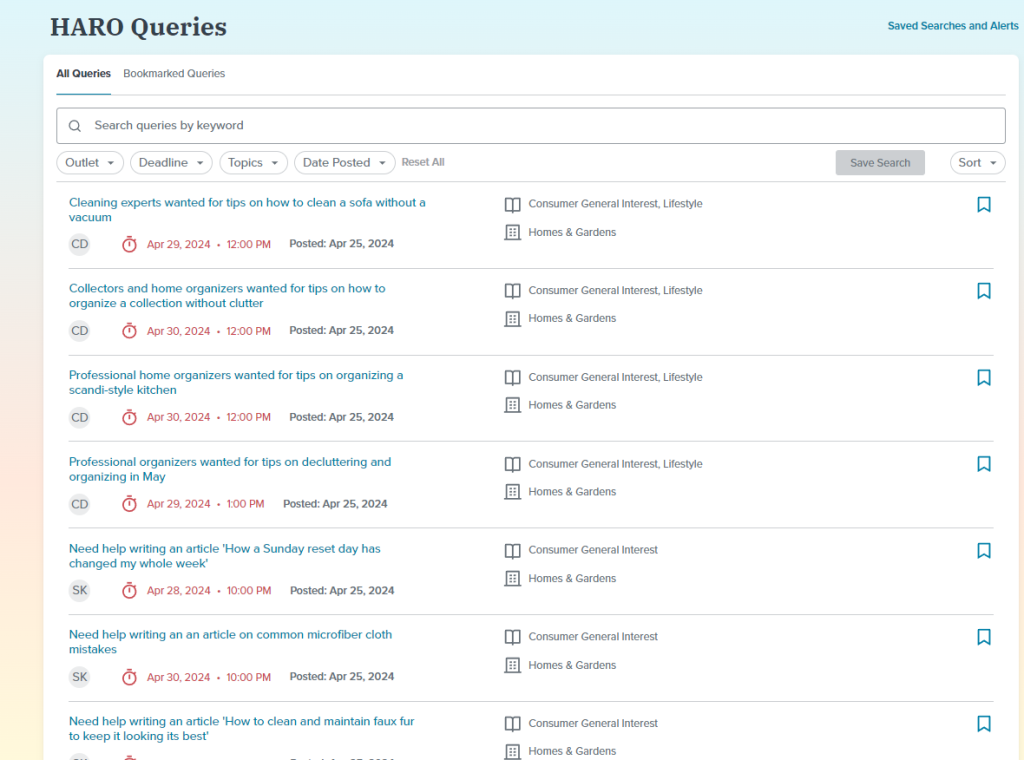
Going through dozens of emails for HARO can be tough and time-consuming. Instead, you can use Connectively, which is established specifically for HARO users. With it, you can sign up and choose from different response subscription plans.
You can search for queries using specific keywords related to your niche and expertise there. It helps you narrow the searches and find the best fit for your niches. Also, the platform has a separate segment for "Pitches," where you can see and track all your responses. So, it's beneficial to manage and follow the queries and responses better and in more organized ones.
Build a Professional Account for HARO Link Building:
Your chance of getting HARO links largely depends on your professional HARO account setup, even if your pitches are perfect, most informative, and engaging. If your HARO account doesn’t look professional, most journalists won’t even bother to open your response. And it diminishes your chance to impress them with your pitches.
So, start with a professional email address instead of your cute nicknames and numbers in the email ID. Your email should reflect your brand or expertise. It could include your name and company name. For instance, if your name is Jonathan Trot and you are working for a Digital Marketing company, your email could be the following:
- Jonathon@digitialmarketing.com
- Jtrot@digitalmarketing.com
Also, do you have a website or social media presence? If so, use the same domain name in your email address. It creates a cohesive online footprint.
Next, you need to create a professional signature for your HARO emails. It should include:
- Your name, title, company name, and website address (If you have one).
- The signature must be brief to avoid overwhelming the recipient.
- Use the same font, style, and colors across your communications. It is necessary for a polished appearance.
Identify Relevant Queries
If you sign up for HARO through emails, it will send three daily emails with different queries. Each query specifies the topic, deadline, and contact information. You must scan these emails, focusing on the following queries:
- Respond to those queries you have expertise and can provide valuable and insightful information for the report instead of responding randomly. Also, in Connectively, you can only respond to limited queries in free-version. So, be specific with it.
- The query you are responding to must align with your brand image and target audience.
For instance, if you are a marketing consultant specializing in social media growth strategies, you can respond to queries such as "Expert tips on utilizing short-form video content for brand awareness."
It is necessary since you can only send “10 pitches” in the free version of Connectively for HARO. So, you mustn’t spend these valuable pitches with random ones. Putting things short, stop spamming HARO pitches.
HARO emphasizes quality over quantity. You should only offer valuable contributions with your expertise instead of responding to irrelevant queries. If you continue responding to unrelated queries, it could damage your reputation. Also, HARO could flag your account as spam and limit your use.
Be alert and respond faster
Journalists and reporters looking for real-life examples, answers, and insights for their stories need the responses quickly. So, you should be on your toes to respond to the emails as fast as possible. HARO will send you with queries three times a day:
- 5:35 a.m. EST
- 12:35 p.m. EST
- 5:35 p.m. EST
So, schedule your work time according to it. The faster you check the emails, filter through the emails, and give your answer to specific questions, the better your chance to impress the journalist.
Are you unsure about your schedule? If so, you can hire an assistant who can help you with the filters and provide you with the topics. After that, you can answer them with expert opinion.
The key is to build a HARO link-building team and work with patience. You can divide the workload among two to three people who will sort out the required emails, research, and prepare the answers. It considerably boosts the chance of getting HARO links
You can set up email alerts for HARO emails for the best results and fastest response. It will ensure you see them promptly.
Craft a Compelling Pitch
The secret to getting HARO links from high-authority websites is to prepare the pitch as informatively as possible. It should be:
- Informative
- Compelling
- Practical and useful
- Precise and on-point
Hence, you must craft the pitches with proper engagement and ideas to grab the journalist's attention. Also, the pitch should convince them to feature you. Here are the key elements for a compelling HARP pitch:
- Catchy Subject Line: The subject must be concise and under 70 characters. It must highlight your expertise and what your pitch will offer to the reporter. The subject line must include "HARO" at the beginning. It helps the reporter immediately recognize it as a response to their queries.
- Brief Introduction: In the central section, briefly introduce your required credentials and relevant experience in the niche. It should be 50 to 60 words at most.
- Address the Query: After the brief introduction, address the query and your understanding of it. For this, you can use references and specific keywords or phrases that the journalist has used in his queries.
- Offer Valuable Insights: In the main section, provide concise yet impactful insights. It should be around two to four sentences with medium length. Use bullet points or numbered lists for easy readability.
- Call to Action: Encourage the journalist to contact you for further information or an interview.
For example, suppose a reporter asks how to use short videos for growth on social media platforms. In that case, your Subject Line can be: "HARO: Social Media Growth Expert: Tips for Utilizing Short-Form Video Content."
The pitch body for this subject line can be:
“Dear [Journalist Name],
I found your query about utilizing short-form video content for brand awareness. As a social media consultant, I've helped many people and brands grow their brand identity on Facebook and TikTok. I’ve 5+ years of experience achieving significant audience growth with different brands.
From my industry knowledge and working experience, here are some essential tips I recommend for boosting brand awareness through short videos on social media:
- Focus on creating engaging and informative content
- Use numbers and stats wherever possible within the videos
- Optimize your videos for mobile viewing with better experience
- Utilize trending hashtags, music, and sounds.
- Post your videos after office hours but before dining time for best reaches
I'd love to explore the topic and share additional strategies for your article. Feel free to reach out at [your email address].”
Format for Quick and Easy Readability
Journalists are often pressed for time and receive overwhelming responses to their queries. So, your pitch must be concise and on-point. You must ensure that your pitch is easy to read and scan.
For this, you can use these formatting ideas:
- Include only 2-3 sentences per paragraph. Also, the sentences should be at most 14 to 16 words long, or they will look cluttered.
- Present key points clearly and concisely using bullet points, numbers, and stats.
- You can highlight important information with bold fonts. However, don’t use different colors as it looks cluttered and painful for the eyes.
Filter the queries for better results
HARO bombards you with hundreds of daily queries from journalists through their three emails. It is nearly impossible to check all those emails and queries individually. Instead, you can set filters in your email to quickly find the most relevant queries.
You can create filters if you sign up to HARO from Gmail.
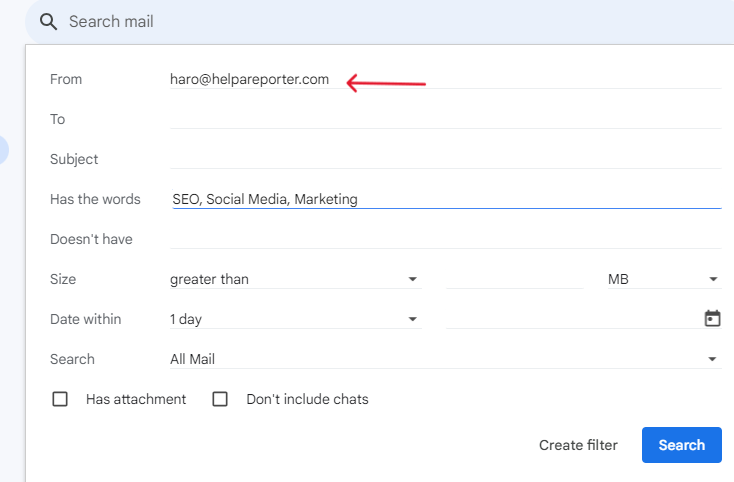
- In your Gmail, click on the “Show Search Options” menu on the right-hand side of the search box.

- In the from section, include HARO “haro@helpareporter.com.” With it, you can quickly find emails only from HARO.
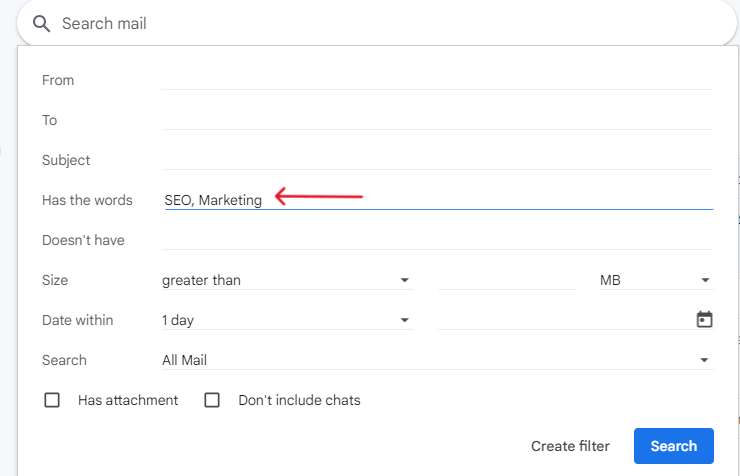
- Next, in the “Has the Words” section, include the related keywords so Gmail quickly takes you to those queries containing the words.
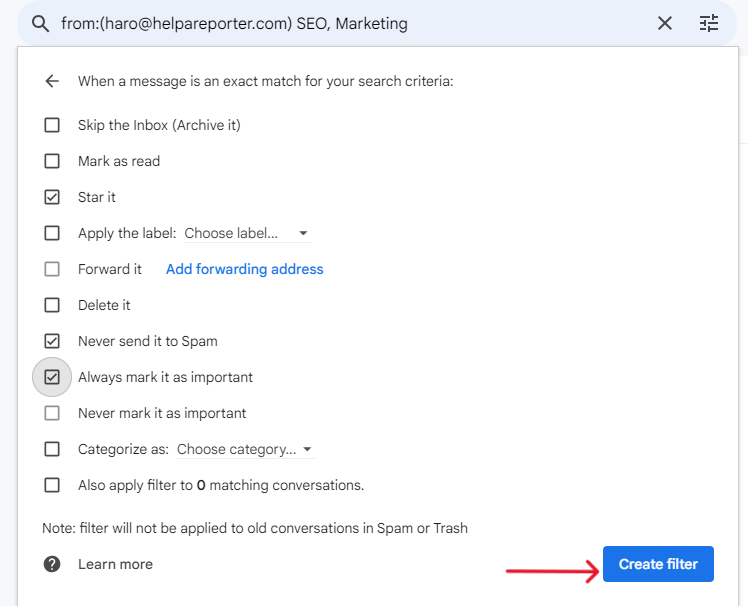
- Go to the "Create Filter" option, and your filter will be ready. It will help you quickly find relevant emails and queries.
Nonetheless, HARO these days uses their Connectively app for users. You can also create filters there to find your relevant searches from journalists. For this, do the following steps:
- In the search box, include the keywords you want for the search queries.
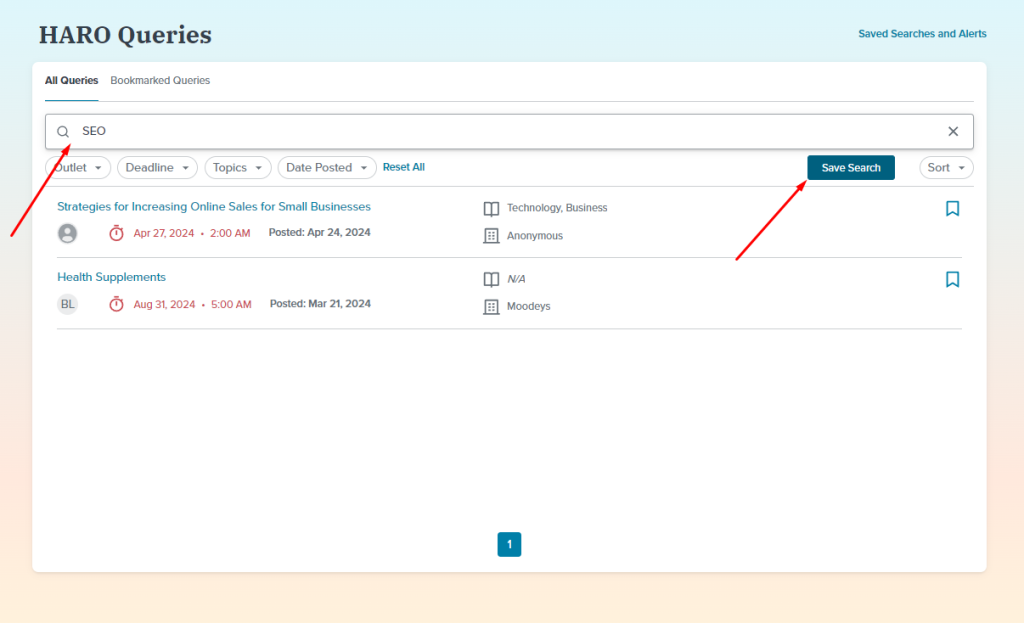
- Then, you can “Save” it to apply it for all the HARO queries in the future. It will show the related keywords and their searches from the reports.
It will help you get exact-matches searches and only work with them.
See the requirements sections
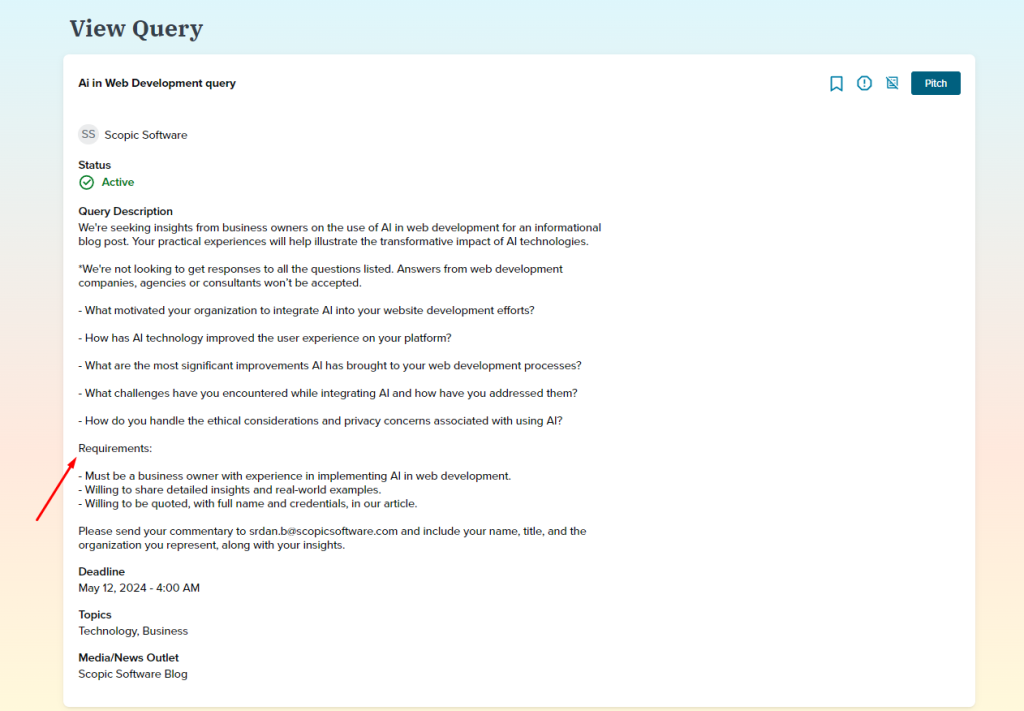
Before you start pitching for any searches, you must check the requirement section of it. You will find the “Requirements” section right after the “Query Description” part once you open the body of the email or query. If your expertise matches the requirement, proceed to write the pitch. It boosts the chance for your pitches to be accepted more.
Once you click on the “Pitch” segment, you will see the box that looks like the following image. There, enter a catch subject and proper description as we described earlier.
Be patient
HARO link-building takes time. So, you must be patient and work gradually to get your pitch accepted and the link published. You can get two to three links in every 10 to 15 pitches.
Thus, your pitches must be perfect and catchy without general and random talks. Reporters receive almost hundreds of queries for each of their searches. They will, hence, need time to go through the responses they receive and select the one that best fits their requirements.
It can take even months and can be nerve-wracking for you. We suggest you go slow and steady and wait until the deadline is over for each query. The wait and labor you put into getting one HARO link is worth it since it may cost you $300 to $1000. Plus, it boosts the EEAT of your website, which Google loves madly.
Build Relationships with Journalists
Of course, your immediate goal is to secure a link from the journalist. Yet, you should build genuine relationships with journalists for your future benefit. You must respond thoughtfully to their queries, even if you're not featured in that piece.
Although they may not feature your pitch for the first time, it opens up future opportunities. You should follow up respectfully for your response, too. Once the deadline is over, or at least 48hrs to 72hrs have elapsed, you can politely send a follow-up email.
Track Your Works
You must monitor your accepted and rejected pitches, published backlinks, or media mentions. You can do it simply with a Google Spreadsheet that will include:
- Question for the search you pitched
- Name of the media or website outlet
- Link to your answer or pitch
- Journalist Response (Yes/No)
- Data Sent and Deadline
You can streamline it as you wish to meet your preferences. Alternatively, you can use online tools such as:
Backlink Monitoring Software: Monitor new backlinks using tools like Semrush or Ahrefs. With it, you can even check the authority of the website you are pitching for and see its details. Media Monitoring: You may use Google Alerts and Mention to track your name's or brand's online mentions.Leverage Your Success
After all these efforts, time, and patience, you got your first HARO link published. So, what to do next? It's time to use the published link for your brand promotion. You can use it in different ways, which might include:
Search for positive quotes from published articles to feature them in the testimonial section of your website. Share news of your feature on social media. You can tag the journalists with gratitude if they allow it.
Leave a comment